

Ogee Domes in Lead: Curved Roof Detailing & Installation
Ogee domes are among the most complex heritage roof forms. Correctly detailed ogee domes in lead require precision bay setting-out, decorative rolls and careful bossing. This guide explains how to achieve long-lasting, heritage-standard finishes in line with Leadwork Standards.
1. Code Selection
Code 6 or Code 7 lead is required for domes, depending on height and exposure. Heavier codes resist distortion across curved surfaces.
2. Bay Setting-Out
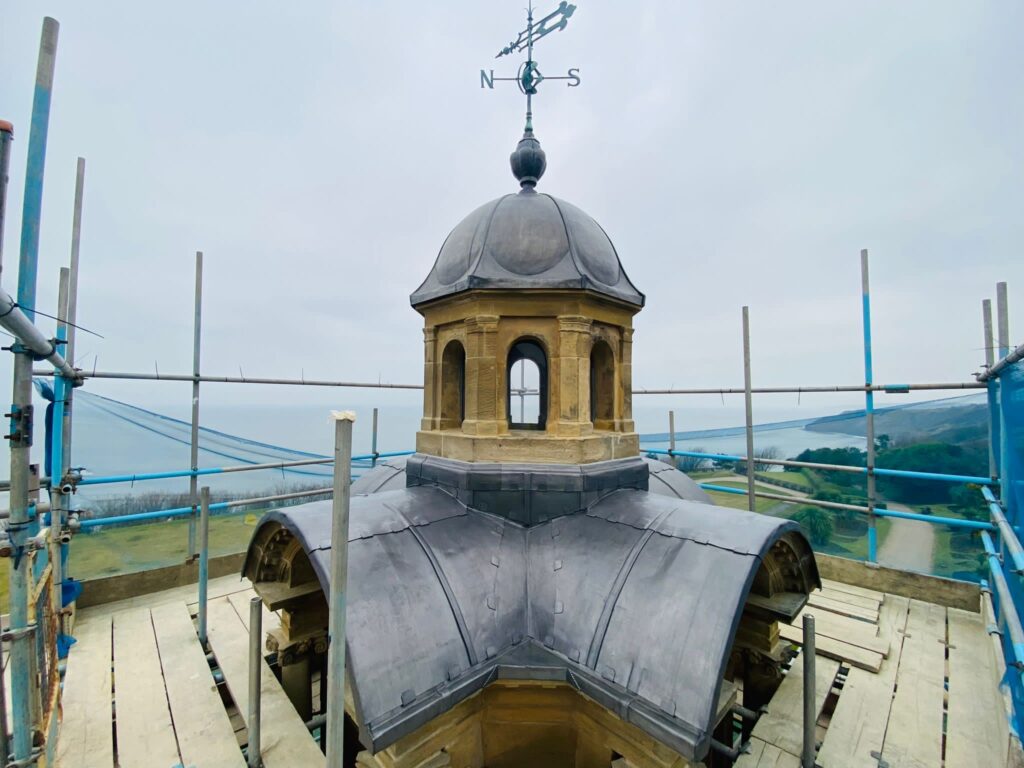
Bays must be set out symmetrically from the dome centreline. Keep bay widths below 1 m. Vertical wood-cored or standing rolls divide bays and allow for expansion.
3. Handling Complex Curvature
Lead must be bossed carefully to follow the ogee curve. Overstretching should be avoided. Bossing mallets and lead dressers are essential to work the sheet without tearing.
4. Decorative Rolls & Heritage Finishes
Decorative rolls are often specified to accentuate dome geometry. Rolled joints should align with architectural features and terminate cleanly at the dome base and finial.
5. Finials & Apex Detailing
The apex of the dome usually features a lead bossed cap or finial. Joints must be welted and may be soldered depending on detailing. This area requires meticulous craftsmanship.
FAQs
What lead code is best for ogee domes?
Code 6 or Code 7 lead is recommended, depending on height, size and exposure.
How are dome bays divided?
Into vertical bays under 1 m wide, separated by wood-cored or standing rolls for movement and decoration.
How is lead shaped to fit an ogee dome?
By careful bossing with mallets and dressers, avoiding overstretching that can thin or crack the lead.
What decorative features are common on domes?
Decorative rolls emphasise symmetry, while finials or bossed caps provide a strong finish at the apex.
Do ogee domes need regular maintenance?
Yes. Inspect joints, rolls and the apex regularly. Apply patination oil to exposed surfaces to reduce staining.
Next in the series (Post 16): Lead Cladding for Towers — vertical detailing, bay setting-out and architectural integration.
