The Lead Lads
BS 6229 Leadwork Substrates
A practical guide to BS 6229 leadwork substrates, roof build-ups, moisture control and proper support for rolled lead sheet roofing.


A practical guide to BS 6229 leadwork substrates, roof build-ups, moisture control and proper support for rolled lead sheet roofing.
The BS 6229 Leadwork Substrates guide explains one of the most important parts of a successful lead roof: the supporting build-up beneath the lead itself. If the substrate is poorly designed or badly formed, even good leadwork can struggle to perform over time.
At The Lead Lads, we treat substrate design as a critical part of proper leadwork. This page sets out the core principles behind compliant support structures, moisture control, falls, insulation strategy and the relationship between BS 6229, BS 6915 and BS EN 12588.
Whether you are a homeowner, contractor, roofer, surveyor or specifier, this page is designed to help you understand how roof build-up decisions affect the long-term performance of lead sheet roofing.
Alongside this guide, you can also explore our Lead Roofing Guides, The Lead Handbook, rolled lead sheet and lead weight calculator for broader technical support, product guidance and buying routes.
Say Hello

Compliance is central to drainage, ventilation and condensation control.

The lead installation is only the covering, not the whole roof build-up.

Proper component parts, sound structure and the right build-up matter.
If you are new to BS 6229 leadwork substrates, begin with the relationship between roof build-up, condensation risk and drainage. If you are specifying work, review BS 6229 alongside BS 6915, BS EN 12588 and BS 5250. If you need materials, browse the shop, guides and handbook. If you need installation support, contact The Lead Lads directly.
New to substrate design?
Start with moisture control, falls and deck support.
Specifying work?
Review BS 6229 with BS 6915, BS EN 12588 and BS 5250.
Buying materials?
Browse guides, handbook resources and product options.
Need a contractor?
Send your enquiry to The Lead Lads.
BS 6229 is the code of practice for flat roofs with continuously supported flexible waterproof coverings. Although it is often discussed in relation to membrane roofs, its principles also matter where lead sheet roofing depends on a properly designed supporting build-up.
For leadwork, BS 6229 becomes particularly important when substrate design, insulation strategy, ventilation, condensation risk and drainage falls all need to work together. In practice, it complements BS EN 12588, BS 6915 and wider LSTA guidance.
Lead is both flexible and heavy. Because of that, it needs full and reliable support beneath it. When the substrate is badly conceived, a range of problems can follow, including deformation, thermal stress, trapped moisture, ponding and premature failure.
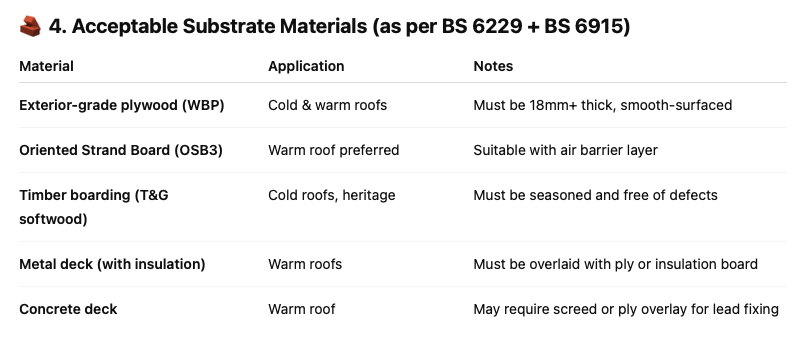
A proper substrate must accommodate:
In a traditional cold roof, insulation sits between or below the rafters, while a ventilated airspace remains above the insulation and below the deck. This means the substrate and moisture strategy must be designed with care to reduce condensation risk.
Typical cold roof requirements include:
In many cases, lead roofing over a cold roof also needs a sensible approach to underlay, abrasion protection and moisture control. Where relevant, BS 5250 should be considered alongside BS 6229.
Warm roof build-ups are often preferred in modern construction. Here, insulation sits above the structural deck, which helps keep the structure warmer and can reduce condensation risk when designed properly.
Typical warm roof requirements include:
Warm roofs need particularly careful design. BS 6229 principles require the build-up to limit interstitial condensation risk, while the lead covering above still needs proper movement allowance and support.
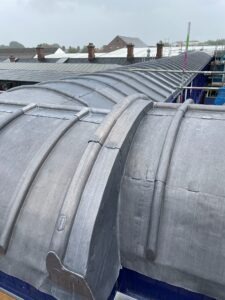
Good drainage is one of the core principles behind BS 6229 leadwork substrates. Without effective falls, standing water can place unnecessary stress on the roof build-up and increase the risk of moisture-related problems.
In short, the substrate must do more than carry the covering. It must help water leave the roof properly.
Lead expands and contracts with temperature change. Therefore, substrate design cannot be separated from movement control. If the supporting build-up is poorly formed, even correctly chosen lead sheet can suffer from avoidable stress.
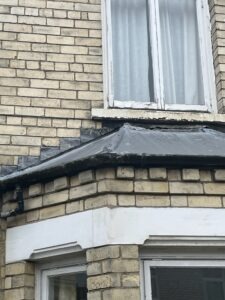
Below the lead covering, the build-up should be stable, dry, well supported and compatible with the rest of the roof. That usually means considering deck type, insulation position, vapour control, drainage falls and separation layers as a complete system rather than as isolated components.
In practice, the lead installation itself is only the visible covering. The long-term success of the work often depends just as much on the unseen structure beneath it.

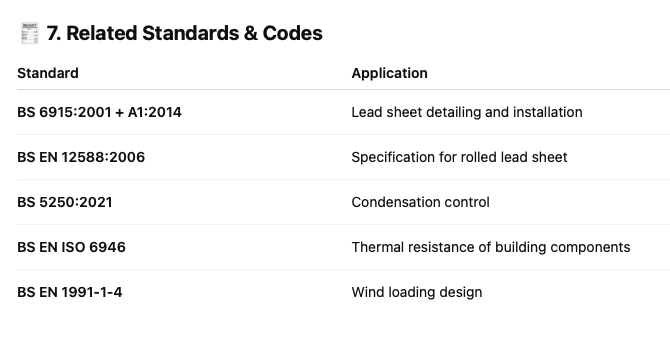
BS 6229 is critical when forming roof substrates that need to remain well drained, thermally robust and resistant to condensation risk. When supporting lead sheet roofing, it should be considered alongside BS 6915, BS EN 12588 and, where relevant, BS 5250.
At The Lead Lads, we can help form substrates so that leadwork installations sit on a build-up that supports compliance, durability and long-term performance. We also work closely with joinery specialists and wider roof teams where substrate formation needs to be coordinated before lead installation begins.
Whether we are acting as principal contractor or specialist subcontractor, we offer the same guidance on substrate preparation before any lead sheet roof covering is installed.
Arrange a SurveyThis support section brings together the most useful follow-on resources from the page, including FAQs, a practical checklist and direct links to standards, services and technical references.
Book a site visit or request a specification aligned with BS 6229, BS 6915 and LSTA guidance.
Send Your Enquiry Recent ProjectsBS 6229 sets out best-practice principles for flat roof design and performance, including moisture, thermal and drainage considerations. For leadwork substrates, its principles help ensure the build-up beneath rolled lead sheet supports durability, drainage and condensation control.
BS 6229 helps guide the roof build-up and moisture strategy, while BS 6915 and LSTA guidance focus more directly on leadwork design, detailing and workmanship. Used together, they provide a stronger framework from substrate to finished covering.
Common well-prepared substrates include suitable plywood, close-boarded softwood and rigid board systems over structural decks. The key requirement is a stable, smooth, dry and compatible base.
Yes. Whether the roof is warm, cold or hybrid, the insulation strategy influences dew-point position, ventilation needs and substrate dryness. That is why the roof build-up must be coordinated carefully from the start.
Yes. Where condensation risk or moisture movement is relevant, BS 5250 should be considered alongside BS 6229 so that ventilation, vapour control and interstitial condensation risk are addressed properly.
| BS 6229 Leadwork Substrates | Flat roof design principles applied to leadwork build-ups. |
| Vapour Control | Managing moisture movement and condensation risk within the build-up. |
| Warm / Cold Roof | Insulation strategy affecting ventilation, condensation and substrate performance. |
| Falls & Drainage | Designing the substrate and structure to shed water effectively. |

The Lead Lads ® Lead Roof Guide Summer Maintenance Summer Lead Roof Maintenance Guide Summer [...]
Latest News The Lead Lads® Launch UK Franchise Model A controlled expansion designed to professionalise [...]
The Lead Lads ® Lead Roof Guide Spring Inspection Spring Lead Roof Inspections — How [...]
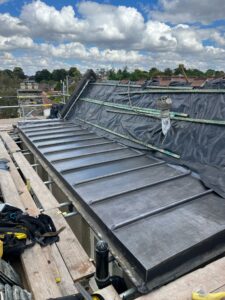
#Proper Leadwork: Lead Ventilation & Condensation—Warm vs Cold Roof Strategies Interstitial condensation is one of [...]
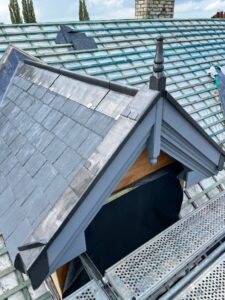
#Proper Leadwork: Edge-to-Edge Detailing—Ridges, Verges & Abutments without Stress Ridges and verges frame the roofline. [...]
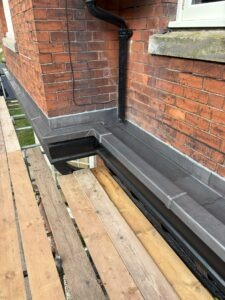
#Proper Leadwork (2026): Upstands & Drips—Heights, Throatings & Edge Geometry Welcome to the New Year [...]

#Proper Leadwork: Lead Soakers—Sizing, Gauges & Interfaces with Slate and Tile Discreet but essential, lead [...]
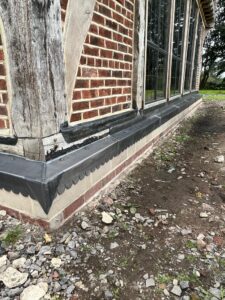
#Proper Leadwork: Cornices, Cappings & Cills—Fixing to Masonry without Cracks Beautiful façades deserve durable lead [...]
Providing proper leadwork services to trade and public.
Our mission is simple: provide high quality services across a range of sectors in rolled lead sheet at a price that is fair, reasonable and proportionate to the skill, detailing and care involved.
This guide explains how to form roof substrates that support leadwork and lead roofing in line with BS 6229. It covers moisture strategy, falls, ventilation, insulation, condensation risk and the wider relationship between substrate design and long-term lead performance.
Get a Quote