The Lead Lads | Flashing Specialists
Lead Flashing Installation
Lead flashing installation for chimneys, abutments, parapets, dormers and roof junctions, carried out by specialist leadwork contractors.


Lead flashing installation for chimneys, abutments, parapets, dormers and roof junctions, carried out by specialist leadwork contractors.
Lead flashing installation protects vulnerable roof junctions from water ingress. It is used where roof coverings meet chimneys, walls, parapets, dormers, upstands and adjoining structures.
At The Lead Lads, we install, repair and replace lead weathering details across domestic, commercial, ecclesiastical and heritage buildings. Our work includes chimney flashing packages, step details, apron flashings, cover flashings, soakers, back gutters and roof-to-wall abutments.
This page explains how these details work, where they are used and why correct setting out, code selection, fixing and thermal movement matter. It also links to material supply through The Lead Shop.
Useful resources include the lead flashing order page, rolled lead sheet, lead weight calculator, leadwork fixings and The Lead Handbook.
Send an Enquiry
Lead roof flashing forms a durable waterproof junction between different parts of a building. It is commonly used at chimneys, wall abutments, parapets, pipes, upstands, dormers and other vulnerable roof interfaces.
Lead remains one of the most effective materials for these details because it is durable, flexible, corrosion resistant and capable of being formed neatly around complex shapes. When properly designed and fitted, it can perform for many decades.
Although the finished detail can look simple, proper installation requires careful setting out, correct lead code, suitable fixing, chase formation, pointing and allowance for thermal movement.
A poorly detailed interface may split, pull away from the wall, leak at the chase or direct water into the roof structure. Good leadwork is not just a strip of material — it is a complete weathering detail.

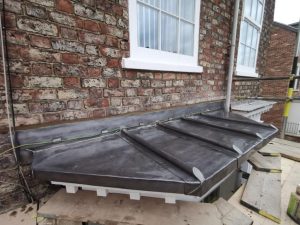
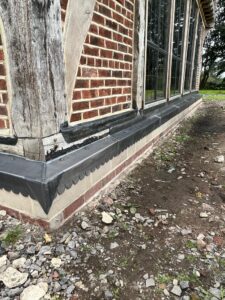
Weathering the lower edge of chimneys, abutments and rising wall junctions.

Traditional stepped weathering chased neatly into brick or stone joints.

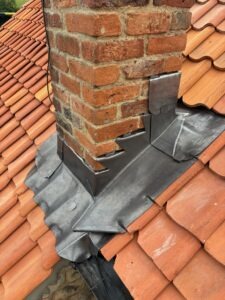
Complete chimney packages with aprons, soakers, cover details and back gutters.
We undertake weathering details as part of a wider specialist leadwork service grounded in proper setting out, workmanship and material use.
Our work ranges from straightforward abutments to more involved chimney packages, stepped interfaces, back gutters, parapet details and roof edge junctions.
These details are often among the most critical components of a roof covering because they protect the areas where water is most likely to penetrate. A failed junction can lead to damp ingress, timber decay and avoidable repair costs.
Apron details are commonly installed where a roof slope meets a chimney stack or higher wall. They weather the front edge and must be dressed correctly onto the roof covering below.
Stepped details are used where a roof abuts masonry on a slope. They are chased into mortar joints in sections, creating a traditional weathering detail.
Back gutters are formed behind chimney stacks and upstands where water must be diverted safely around an obstruction.
Soakers are concealed individual pieces placed beneath adjoining slates or tiles at an abutment. They are commonly formed in Code 3 lead.
Cover details protect the upper edges of soakers, upstands and abutments. They are commonly used with stepped work, parapets and vertical interfaces.
These details should never be judged purely on appearance at the point of installation. Long-term performance depends on code selection, sizing, chase depth, wedging, pointing, movement allowance and careful dressing onto the surrounding roof covering.
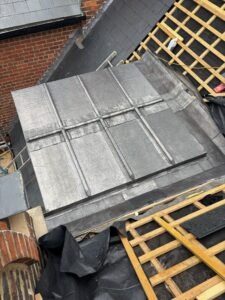
Exposed roof weathering is typically formed using Code 4 lead or Code 5 lead, depending on the detail and exposure. These gauges provide a useful balance between malleability and durability.
For concealed elements such as soakers, Code 3 lead is often appropriate. For heavier or more exposed details, Code 5 or heavier material may be required.
The Lead Shop supports material supply for competent installers, trade buyers and clients planning works, including:
We approach leadwork in line with recognised principles, including Leadwork Standards and BS 6915. Movement, support, fixing and detailing must all be considered properly.
For wider guidance, explore Lead Roofing, The Ultimate Lead Roofing Guide and Lead Roofing Projects.
Get a QuoteLead roof flashing is used to weather vulnerable roof junctions, including chimneys, wall abutments, parapets, dormers, upstands and pipe penetrations.
Yes. Over time, it can deteriorate through age, repeated thermal movement and fatigue. Splits may develop, fixings may loosen and gaps can open at the interface with masonry.
Replacement may be needed if the detail has split, slipped, detached from its chase, degraded significantly or is clearly allowing water ingress.
Code 4 is a common gauge of rolled sheet used in exposed weathering applications. It is identified by a blue label, is approximately 1.80mm thick and weighs around 20.41kg/m². You can buy Code 4 lead online here.
The correct code depends on the detail. Code 3 is commonly used for soakers, while Code 4 and Code 5 are widely used for exposed applications. Heavier codes may be required for larger or more demanding details.
Yes. In addition to installation services, we also operate The Lead Shop, which supplies lead rolls, fixings, patination oil and guidance.
In many cases, yes. Clear photographs, dimensions, sketches and drawings help us assess whether guide pricing or a formal quotation can be provided.
Yes. We undertake chimney packages including aprons, side details, stepped cover work, soakers and back gutters.
We supply lead materials online and undertake specialist leadwork across Yorkshire and beyond.
Shop Materials Request a QuoteProviding proper leadwork services to trade and public. Our mission is simple: deliver high-quality leadwork across a range of sectors in rolled lead sheet at a price that is fair, reasonable and proportionate to the skill, detailing and care involved.
Roof weathering details should always be considered in proper context. If you need advice on a chimney package, abutment, back gutter, parapet detail or wider leadwork scheme, contact us and we will review your enquiry.
Get In Touch
Lead Lads® Wakefield
Operated by Penman Leadwork & Roofing Ltd
12 Woodside, Wrenthorpe
Wakefield, WF2 0LE
United Kingdom
All rights reserved

The Lead Lads ® Lead Roof Guide Summer Maintenance Summer Lead Roof Maintenance Guide Summer [...]
Latest News The Lead Lads® Launch UK Franchise Model A controlled expansion designed to professionalise [...]
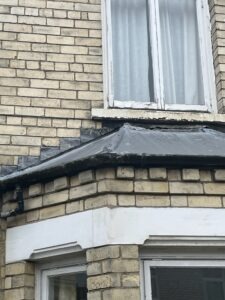
The Lead Lads ® Lead Roof Guide Spring Inspection Spring Lead Roof Inspections — How [...]
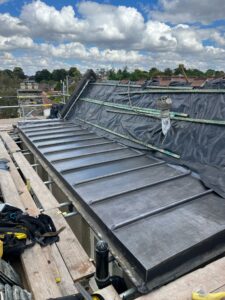
#Proper Leadwork: Lead Ventilation & Condensation—Warm vs Cold Roof Strategies Interstitial condensation is one of [...]
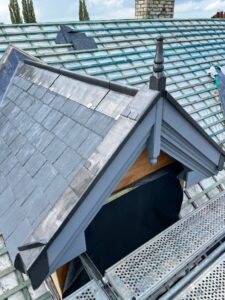
#Proper Leadwork: Edge-to-Edge Detailing—Ridges, Verges & Abutments without Stress Ridges and verges frame the roofline. [...]
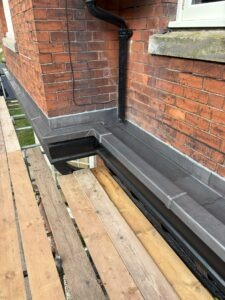
#Proper Leadwork (2026): Upstands & Drips—Heights, Throatings & Edge Geometry Welcome to the New Year [...]

#Proper Leadwork: Lead Soakers—Sizing, Gauges & Interfaces with Slate and Tile Discreet but essential, lead [...]
#Proper Leadwork: Cornices, Cappings & Cills—Fixing to Masonry without Cracks Beautiful façades deserve durable lead [...]