


THE LEAD LADS® / PROJECT ARCHIVE
Specialist curved leadwork to a Grade II listed property in York, incorporating Code 5 gutter linings, bay coverings, timber core rolls, expansion joints, outlets, cornice details and traditional flashings.
RATHBONE HOUSE · YORK · GRADE II LISTED · CURVED LEADWORK
Explore the Project01 — THE PROJECT
At Rathbone House on Tadcaster Road, York, The Lead Lads® undertook specialist renewal of the leadwork to one of the building’s distinctive curved front bays.
The Grade II listed property, formerly known as Moorlyn, dates principally from the nineteenth century. Its curved bays form an important part of the architectural composition of the principal elevation.
The project therefore required more than straightforward weatherproofing. New gutter linings, bay coverings, flashings, outlets, rolls and cornice details had to follow the existing curved geometry while preserving the proportions and character of the frontage.
LEADWORK IN YORK →
SPECIALIST LEADWORK →
LEADWORK STANDARDS →

LOCATION
PROGRAMME
LEAD CODE
DESIGNATION
02 — THE CHALLENGE
The existing leadwork had deteriorated to the point where comprehensive renewal provided the appropriate long-term solution.
Curved bays are technically more demanding than simple flat lead coverings. Gutters, outlets, rolls, flashings, cappings and cornice details converge within one prominent feature, while the geometry itself introduces additional complexity during setting out and formation.
The leadwork also sits prominently within the principal elevation of a listed building. Technical performance therefore had to be achieved without compromising the architectural form of the bay.
03 — TECHNICAL APPROACH
The new leadwork was designed around three fundamental requirements: accommodating thermal movement, providing reliable drainage and accurately following the curved form of the existing building.
Code 5 rolled lead sheet was used across the principal new details, with T-Pren expansion joints incorporated within the gutter linings to assist with movement control.
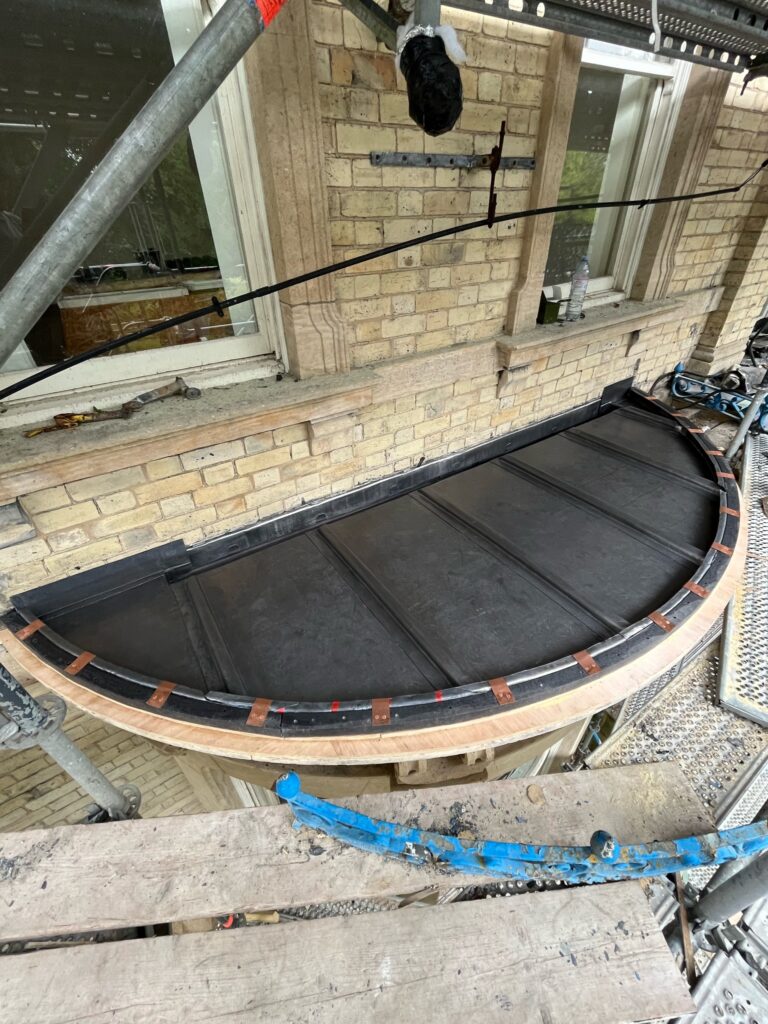
Bossing and welding allowed the material to be formed around the more complex changes in geometry, while timber core rolls established the shape and support required beneath the finished covering.
BS 6915 Leadwork →
The Lead Handbook →
Lead Roofing Guides →
Historic England Listing →

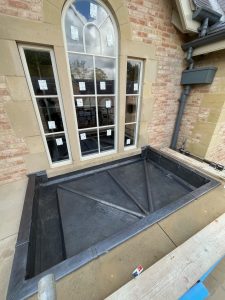
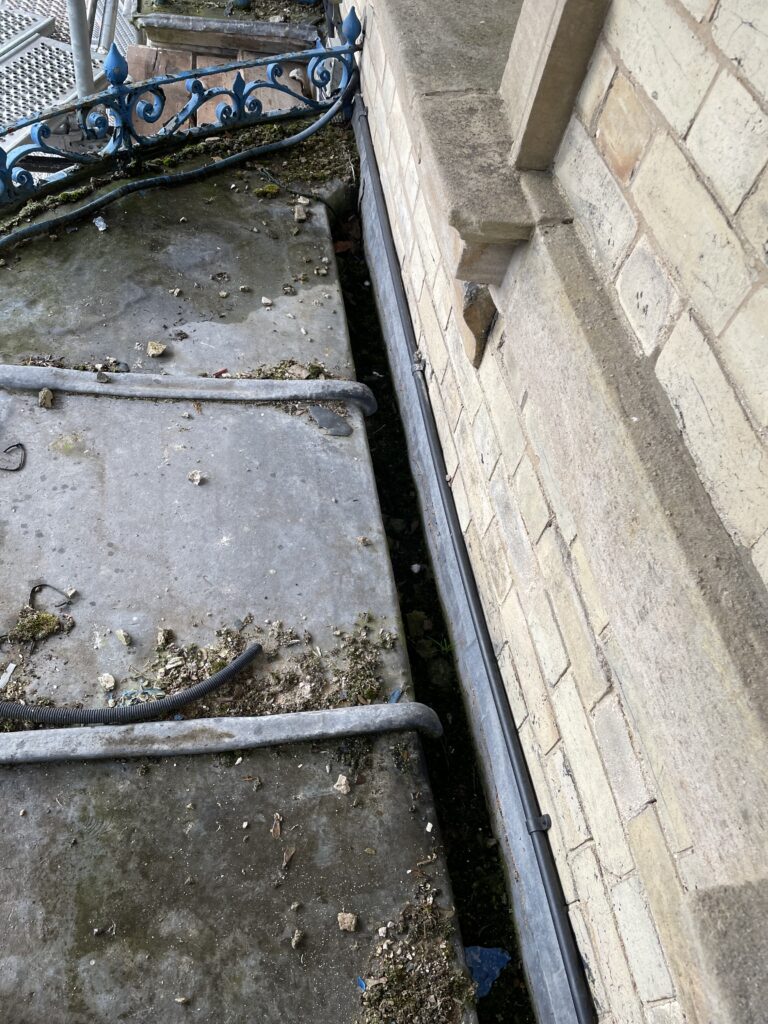
The original curved bay before renewal of its lead coverings and drainage details.
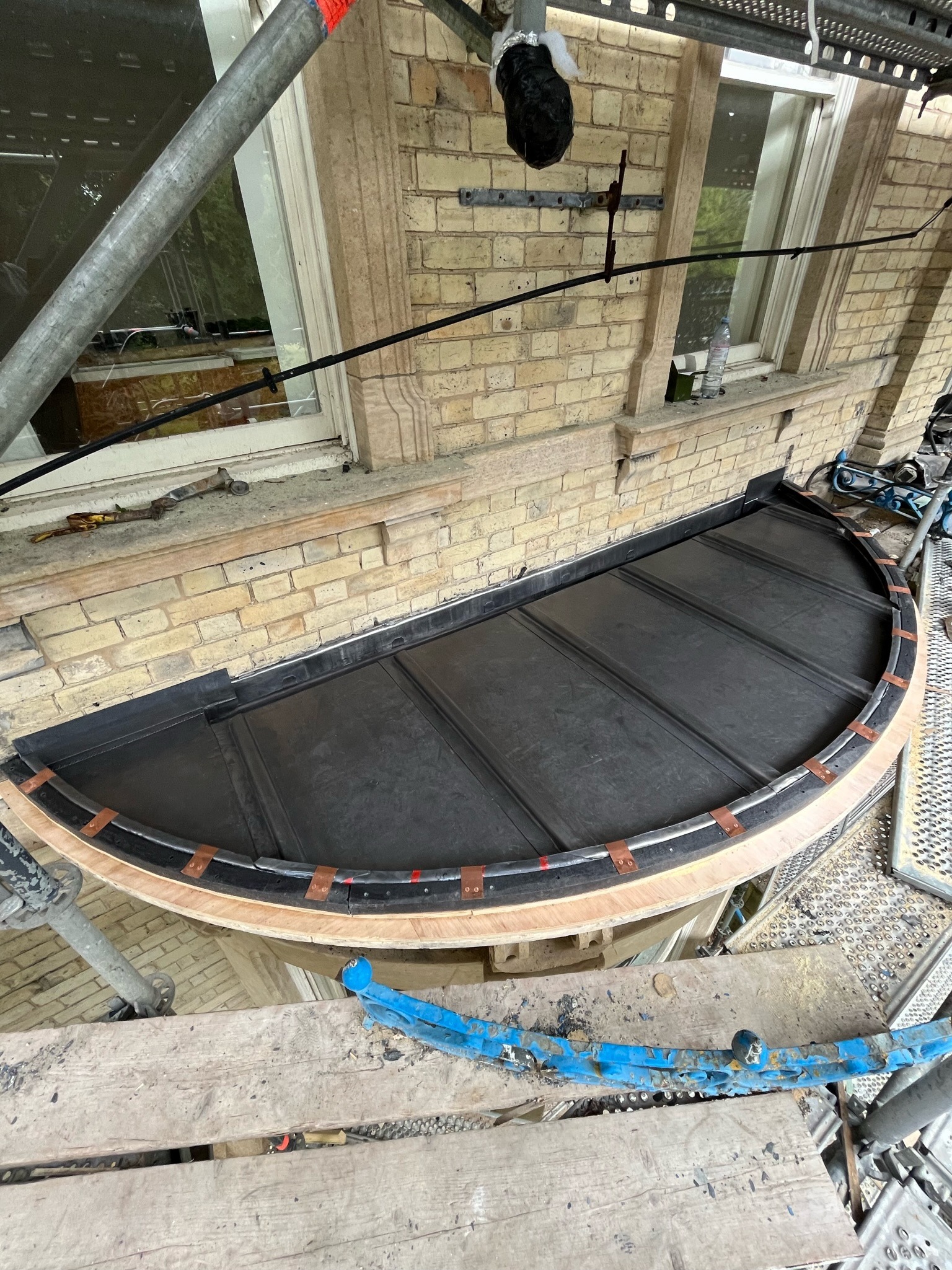
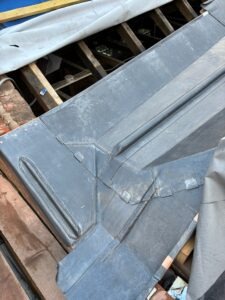
Curved substrate, core rolls and leadwork carefully formed around the geometry of the bay.
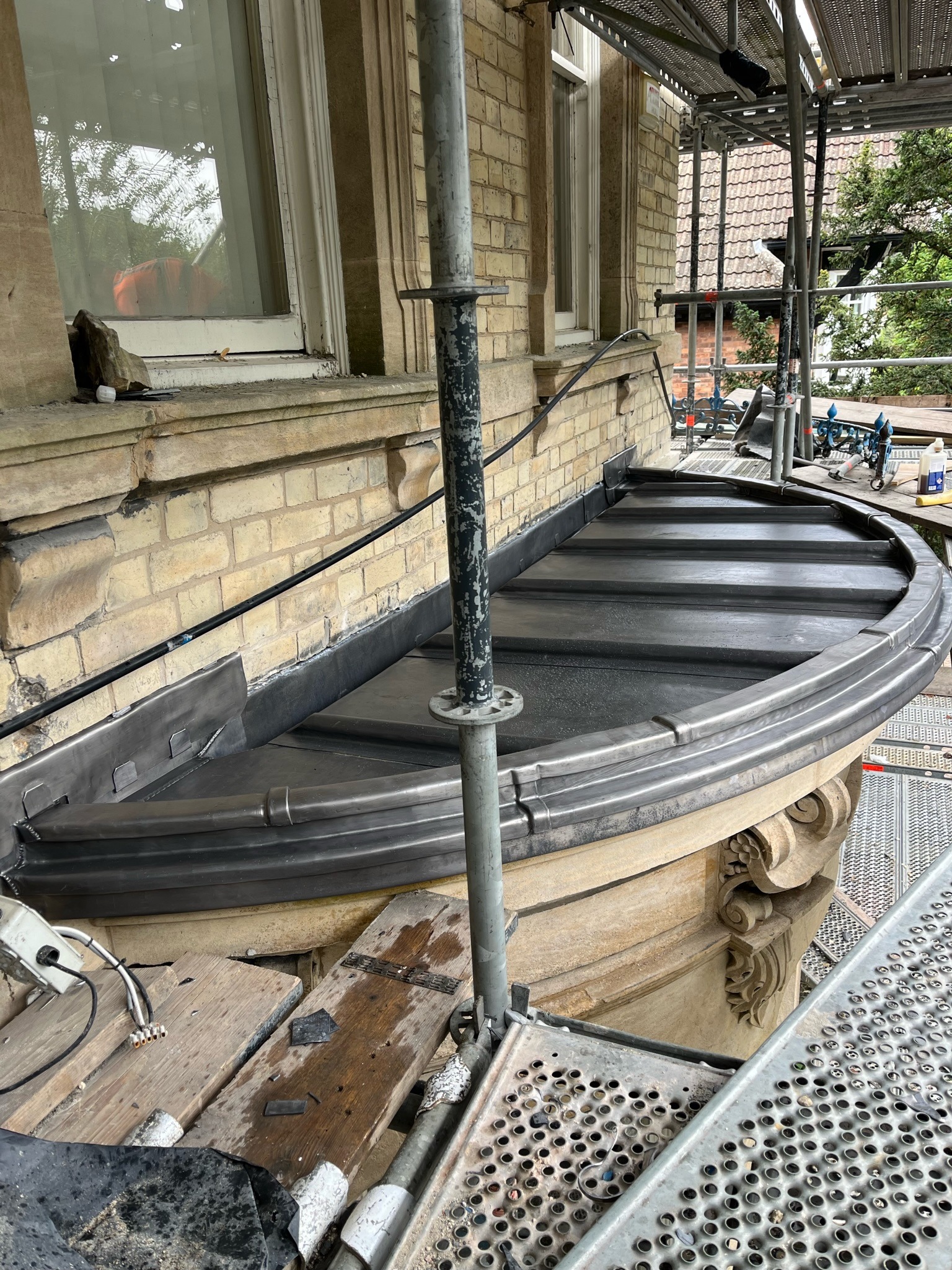
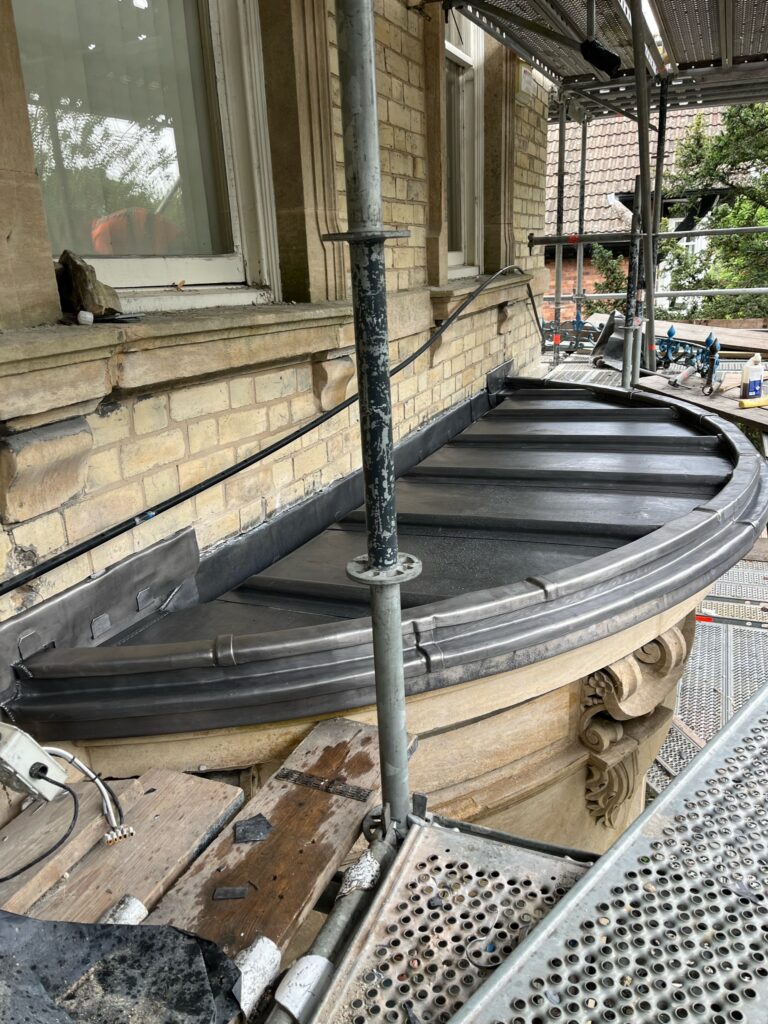
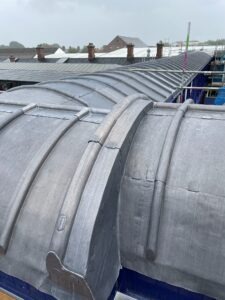
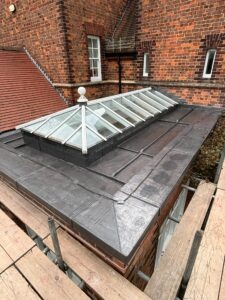
Code 5 lead follows the curved frontage while providing a complete weathering system.
04 — PREPARATION + FORMATION
05 — LEADWORK INSTALLATION
06 — SIGNATURE DETAIL
The defining feature of this project is the geometry itself. Unlike a conventional rectangular bay, the lead covering, gutter and perimeter details follow a continuous curved frontage.
This places greater emphasis on accurate setting out and traditional leadworking techniques. Core rolls must follow the architectural line, sheet must be dressed without introducing excessive stress, and outlets and joints must function within a non-linear arrangement.
The completed leadwork therefore becomes both a weathering system and part of the architectural expression of the building.

07 — MATERIALS
ROLLED LEAD SHEET →
LEADWORK FIXINGS →
LEAD SIZING + ORDERING CHART →
08 — LEADWORK SKILLS
Curved architectural leadwork brings together several traditional skills within a single detail.
09 — PROJECT RECORD
The photographic record shows the condition of the curved bay before work, the formation of the replacement leadwork and the completed architectural detail.
For specialist work of this type, the construction-stage photographs are particularly valuable: they reveal the setting out, support and formation hidden beneath the finished surface.
10 — THE BUILDING
Rathbone House, formerly Moorlyn, is a Grade II listed property on Tadcaster Road in York.
The building’s curved front bays are amongst the features that give the principal elevation its distinctive character. Renewal of the leadwork therefore needed to respect the existing geometry rather than simplify or visually alter the feature.
Projects of this type demonstrate the role traditional lead sheet continues to play in conserving historic building fabric: it is sufficiently malleable to follow complex architectural forms while providing a durable weathering layer when correctly detailed.
11 — TECHNICAL KNOWLEDGE
The performance of architectural leadwork depends on correct material selection, sheet sizing, fixing, movement allowance and workmanship.
Leadwork Standards →
The Lead Handbook →
Lead Roofing Guides →
Lead Flashing →
Rolled Lead Sheet →
12 — WHAT THIS PROJECT SHOWS
Successful curved leadwork depends on far more than dressing sheet around a radius.
The gutter linings, outlets, expansion provision, core rolls, cappings, cornices and abutment flashings must work together while following the geometry of the underlying building.
This project demonstrates why curved architectural leadwork remains a specialist discipline: water management, material movement and visual appearance all have to be resolved simultaneously.
PROPERTY OWNER TAKEAWAYS
13 — FREQUENTLY ASKED
Code 5 lead is commonly used for many fully supported architectural details of this type, although the correct lead code and sheet arrangement depend on the dimensions, geometry and exposure of the individual project.
Lead expands and contracts as temperatures change. Where gutter dimensions or geometry require it, correctly specified expansion provision can help accommodate this movement and reduce stress within the sheet.
Curved features often combine gutters, rolls, cappings, outlets, flashings and changes in geometry. Accurate bossing, welding, dressing and setting out may all be required to complete these details successfully.
14 — MATERIALS + RESOURCES
The Lead Lads® project archive connects completed specialist leadwork with the materials and technical information used throughout the trade.
Lead Roofing Projects →
Leadwork Services →
Lead Sizing + Ordering Chart →
Rolled Lead Sheet →
Leadwork Fixings →
Lead Lads Shop →
THE LEAD LADS® / PROJECT ARCHIVE
Rathbone House forms part of The Lead Lads® project archive documenting lead roofs, curved bays, gutters, valleys, flashings, canopies and traditional architectural leadwork.
The archive records real materials, detailing, problems and construction methods — connecting specialist craftsmanship with technical guidance and the products used to deliver the work.