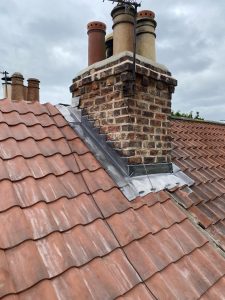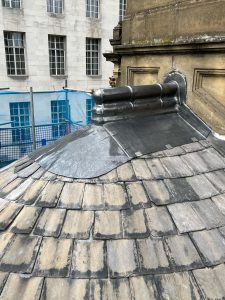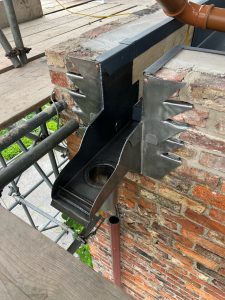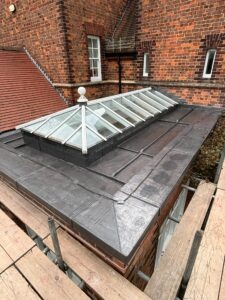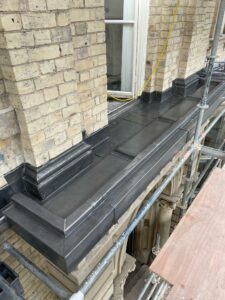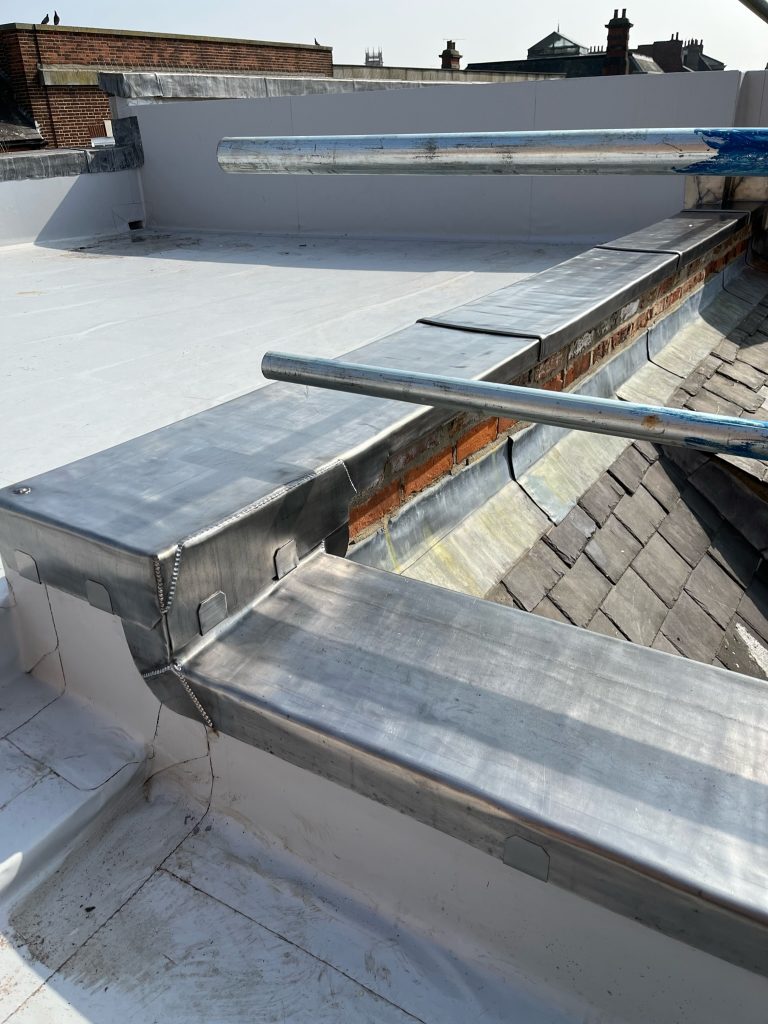




This lead capping project was completed in around 5 days.


The Lead Lads provide specialist leadwork services for parapet cappings, flashings, gutters, bays and bespoke roof details.
This project involved the supply and installation of a new lead capping to a parapet wall on a commercial property in York city centre. The main roof covering had been formed using a single ply membrane by our client, with The Lead Lads engaged to complete the specialist perimeter capping detail.
The leadwork was primarily required for visual finish and long-term weather protection. Parapet wall cappings are highly exposed details, so the finished covering had to be neat, secure and capable of resisting wind uplift while allowing natural thermal movement.
Working in central York required careful planning. To reduce time on site, the leadwork was accurately measured and prepared off site before being transported for installation and final finishing.
Parapet walls are vulnerable to water penetration if the top of the wall is not properly protected. Poorly detailed cappings can allow moisture into the masonry, leading to staining, frost damage, decay and deterioration of adjoining roof finishes.
On this project, the new Code 5 lead capping provided a durable and visually appropriate finish to the perimeter wall. Continuous stainless steel clips were used to secure each edge, helping to reduce the risk of wind uplift in an exposed roof position.
This project was completed using a standards-led approach focused on correct material selection, neat panel formation and secure perimeter fixing.
The key principle was to form a clean capping detail that could be installed efficiently on site while maintaining proper movement allowance. The lead was formed in welted panels, clipped continuously to each edge and welded at abutments where required.
Contact us about leadwork More leadwork resources and guides The leadwork LinkThis project used a focused set of materials selected for a clean, durable and secure parapet capping detail.
If you are trying to understand which code of lead is right for a similar detail, our shoppable lead chart is a useful starting point. For broader product learning, see The Lead Handbook and our lead roofing guides.
The Lead & Materials Used By Us 🛒 Lead Weight Calculator
A parapet capping is a relatively simple detail, but it has an important role in protecting the wall head beneath. If the top of the wall is left exposed or poorly capped, water can enter the masonry and cause staining, frost damage and decay over time.
This project shows how off-site preparation can help when working in busy city centre locations. Accurate measuring, pre-cut panels, welted joints and continuous edge clipping allowed the leadwork to be installed efficiently while still achieving a high-quality finish.
A lead parapet capping is a formed lead covering that protects the top of a parapet wall from rainwater.
Code 5 lead is often suitable, depending on the width, exposure and detailing requirements.
Welted panels create neat joints while helping manage thermal movement across the capping.
Stainless steel clips help secure exposed capping edges and reduce the risk of wind uplift.
Yes. Accurate off-site preparation can reduce installation time, especially on busy commercial sites.
You can explore lead roll, clips, fixings and guides through the Lead Lads Shop.